Robotaxi: Market Prospects, Core Premises for Development, Economic Viability, and Industrial Chain Landscape
According to Frost & Sullivan's forecast, the global and Chinese Robotaxi service market sizes are expected to reach US$290 million and US$160 million, respectively, by 2025, and US$352.6 billion and US$179.4 billion, respectively, by 2035. Currently, the Robotaxi industry is on the eve of commercialization expansion. We will discuss the prerequisites, economic viability, and industrial chain participants involved in Robotaxi development.
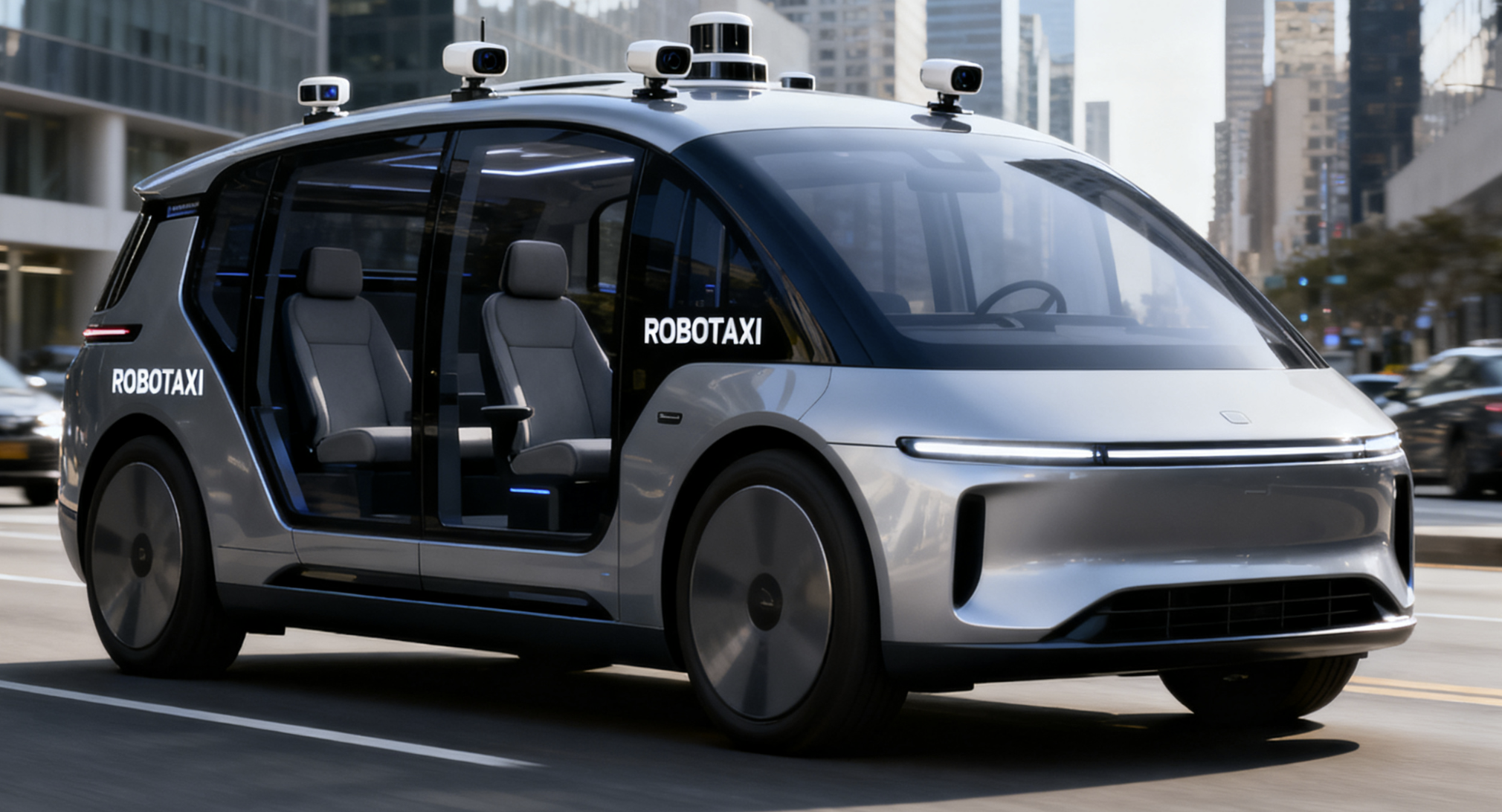
1. Three Core Prerequisites for Robotaxi Development
Hardware Costs: Significant Cost Reduction in Core Components and Vehicle Costs
The sharp decline in LiDAR costs is a crucial hardware breakthrough. Around 2020, the unit price of a 64-line mechanical rotating LiDAR reached $80,000, while by 2025, automotive-grade products like Hesai Technology's AT512 have fallen to approximately $200, directly reducing the hardware cost per vehicle from over CNY 1 million in early stages to a range of CNY 0.2-0.35 million. Leading enterprises have achieved remarkable results in cost control:
Baidu's 6th-generation autonomous vehicle has an overall cost of only CNY 204,600, a 60% decrease compared to the previous generation.
Pony.ai's 7th-generation autonomous vehicle has a cost reduced to CNY 270,000, a 73% drop from the first generation, with potential for a further 30-40% reduction over the next three years.
WeRide's next-generation Robotaxi is expected to see a further 20% - 30% cost reduction.
Company/Model | LiDAR (Unit) | Camera (Unit) | Millimeter-Wave Radar (Unit) | Ultrasonic Radar (Unit) | Platform Computing Power (TOPS) | BOM (RMB 10,000) |
Apollo Go 5th-Generation | 2 | 13 | 5 | 12 | 800 | 48 |
Apollo Go 6th-Generation | 8 | 12 | 6 | 12 | 1200 | 20.5 |
Pony.ai 6th-Generation | 7 | 11 | 5 | 0 | NVIDIA Drive Orin | >100 |
Pony.ai 7th-Generation | 9 | 14 | 4 | 0 | NVIDIA Drive Orin*4,>1000 | <30 |
WeRide | 7 | 12 | - | - | HPC 2.0 ,>1300 | >30 |
AutoX 5th-Generation | 6 | 28 | 8 | - | 2200 | - |
Waymo 6th-Generation | 4 | 13 | 6 | - | - | |
Table: Autonomous Driving Hardware Configuration of Various Companies
Software Technology: Advancement in Safety and Generalization Capabilities Driven by Large Models
The core breakthrough in algorithms lies in the combination of large models and data closed loops. Baidu Apollo's ADFM (Autonomous Driving Foundation Model), launched in 2025, adopts an end-to-end architecture, achieving a safety level 10 times higher than that of human drivers and covering complex urban scenarios. Pony.ai's simulation platform can generate millions of variant traffic scenarios every day, significantly reducing the need for real-road testing and accelerating the iteration cycle.
Technical approaches exhibit diversified competition: Baidu emphasizes vehicle-road-cloud synergy, Tesla adheres to a pure vision solution, and Geely introduces a "one-stage integrated large model", which improves the iteration speed through mutual calibration between cloud and on-vehicle models. Although handling extreme scenarios (such as nighttime construction zones and strong sunlight conditions) remains a key challenge, the industry accident rate is significantly lower than that of human driving.
Policy: Local Pilots Take the Lead, National Framework Takes Shape
China has formed a policy promotion path of "local breakthroughs and national coordination". By September 2025:
54 provinces and cities have issued normative documents on open roads.
28 cities support autonomous driving exploration:
Shenzhen took the lead in issuing intelligent connected vehicle management regulations.
Beijing and Shanghai allow commercial operations without safety drivers.
Wuhan and Chongqing open remote testing permissions.
Regarding financial support, cities such as Shenzhen, Wuhan, and Suzhou have launched subsidies or rewards for vehicle modification, testing fees, and demonstration applications, lowering the threshold for early investment and accelerating vehicle iteration and scenario verification.
The national-level Autonomous Driving Law has not yet been promulgated, and cross-regional regulatory standards remain inconsistent, issues such as accident liability determination and the legal status of remote safety operators are still unresolved. However, local pilot programs have accumulated substantial experience. For example, Guangzhou has achieved 24-hour Robotaxi network coverage, and collaboration with overseas markets like Dubai has also provided references for policy innovation.
2. Economic Efficiency: The Underlying Logic of Robotaxis Replacing Traditional Taxis
Fundamental Reconstruction of Costs
Labor costs are core burden for traditional taxis (accounting for approximately 60% of operating costs), whereas Robotaxis can completely eliminate driver expenses. Assuming an annual operation of 100,000 kilometers, the annual salary of a traditional taxi driver is about CNY 120,000, while the average annual operating cost of a Robotaxi is only CNY 30,000, with maintenance cost at CNY 50,000, indicating a significant long-term cost advantage. According to the OnTime prospectus and Frost & Sullivan’s report, the operating cost of ride-hailing/taxis in 2023 was approximately CNY 1.8 yuan/km, while that of Robotaxis was about CNY 4.5 yuan/km. These costs are expected to be equivalent by 2026, and the operating cost of Robotaxis is expected to drop to CNY 1.0 and 0.9 yuan/km in 2030 and 2035, equivalent to 42% and 36% of the cost of human drivers.

Figure: Forecast of Travel Service Costs, in RMB per Kilometer, 2019 to 2030 (Estimated), Source: OnTime(Chenqi Technology Limited) Prospectus, Frost & Sullivan
Improvement in Service Efficiency and Riding Experience
Robotaxis have the following advantages:
A) 24/7 uninterrupted operation, which increases vehicle utilization by more than 50% compared with traditional taxis.
B) Algorithm-optimized route planning shortens the average driving time by 15% - 20%. Moreover, dynamic dispatching can be realized through vehicle-to-infrastructure (V2I) collaboration, reducing urban traffic congestion.
C) Standardized service processes eliminate industry problems such as detours and refusal to take passengers.
Furthermore, passengers not only benefit from standardized driving performance (which, as autonomous driving technology matures, will probably surpass that of human drivers), but also enjoy a private space, allowing them to effectively convert travel time into productive work or leisure activities.
3. Enterprises Involved in the Industrial Chain
The Robotaxi industrial chain is structured as "upstream (hardware) - midstream (vehicle/OEM/solutions) - downstream (operation platforms/infrastructure)," as detailed in the table below:
Segment | Sub-segment/Role | Representative participants | Key Remarks |
Upstream | Sensors (LiDAR/Cameras/Millimeter Wave Radar) | Hesai Technology, RoboSense, occupy over 80% of the domestic automotive-grade LiDAR market share | LiDAR prices are decreasing rapidly, with significant domestic substitution. |
Upstream | Automotive-grade chips/Domain controller/Algorithm platform | Nvidia (Orin-X), Horizon Robotics (Journey 6), Black Sesame Technologies, Jingwei Hirain, Desay SV | Decline in costs of computing power / domain controllers, optimized computing power unit price. |
Upstream | Steer-by-wire chassis | Bethel, Nexteer, Tuopu Group | Steer-by-wire and brake-by-wire are essential core capabilities for L4 -level vehicles. |
Midstream | L4 algorithm/system integration solutions | Baidu Apollo: The 6th-generation vehicle costs CNY 204,600; "Apollo Go" has accumulated over 11 million orders and is striving for profitability in 2025. Pony.ai: Covers a 2,000- square -kilometer operating area in Beijing, Shanghai, Guangzhou, and Shenzhen; plans to produce 1,000 vehicles in 2025, targeting break-even at a scale of 50,000 vehicles. WeRide: Fleet size of 1,200 vehicles, autonomous driving licenses obtained in six countries. | Multi-sensor fusion + high-precision maps/end-to-end solutions are advancing in parallel. |
Midstream | OEM/Contract Manufacturing | BAIC, GAC Group, SAIC Motor, XPeng, NIO | Pre-installed mass production is accelerating, with both contract manufacturing and joint development. |
Downstream | Operating Platform/Aggregation Platform | Apollo Go, OnTime, Caocao Inc., DiDi | Self-built and third-party platforms coexist, with mixed order dispatching via APPs. |
In terms of business models, the common one is the tripartite cooperation among technology companies, automakers, and operation platforms, such as Baidu (technology) +BAIC/JMC (automaker)+Apollo Go/Baidu Maps (operation/traffic), Pony.ai (Technology) +Toyota/GAC (automaker) +Cao Cao/OnTime (Operation), WeRide (Technology) + GAC/Nissan (automaker) +OnTime (Operation). In addition, Tesla employs an integrated model encompassing vehicle manufacturing, technical services, and operation, thereby building its own ecosystem.
Conclusion
Driven by the triple synergy of continuous decline in hardware costs, rapid software technology iteration, and policy system improvements, Chinese Robotaxis are expected to replace traditional taxis from an economic perspective in the long run. Companies throughout the industrial chain are expected to benefit from this industry trend.
Want to generate reports like this?
This analysis was assisted by AlphaR&D's autonomous agent swarm. Join the waitlist to get access to the tool.
Disclaimer
The investment notes, analyses, and related content provided on this website are for informational and educational purposes only and do not constitute financial advice, investment recommendations, or an offer to buy/sell any securities (including ETFs, FOFs, stocks, bonds, etc.).
All content is based on public information, personal research, and subjective analysis of the author(s), and does not guarantee accuracy, completeness, or timeliness. Past performance of any investment product mentioned is not indicative of future results.
Investing involves inherent risks, including the potential loss of principal. Readers should conduct their own due diligence, consult with a qualified financial advisor, and make investment decisions based on their individual risk tolerance, financial situation, and investment objectives. The website and its author(s) shall not be liable for any direct, indirect, incidental, consequential, or special damages arising from the use of or reliance on the content provided herein.
By accessing and using this website, you acknowledge that you have read, understood, and agreed to be bound by this disclaimer.